
One Icon, Five Demon Tiers
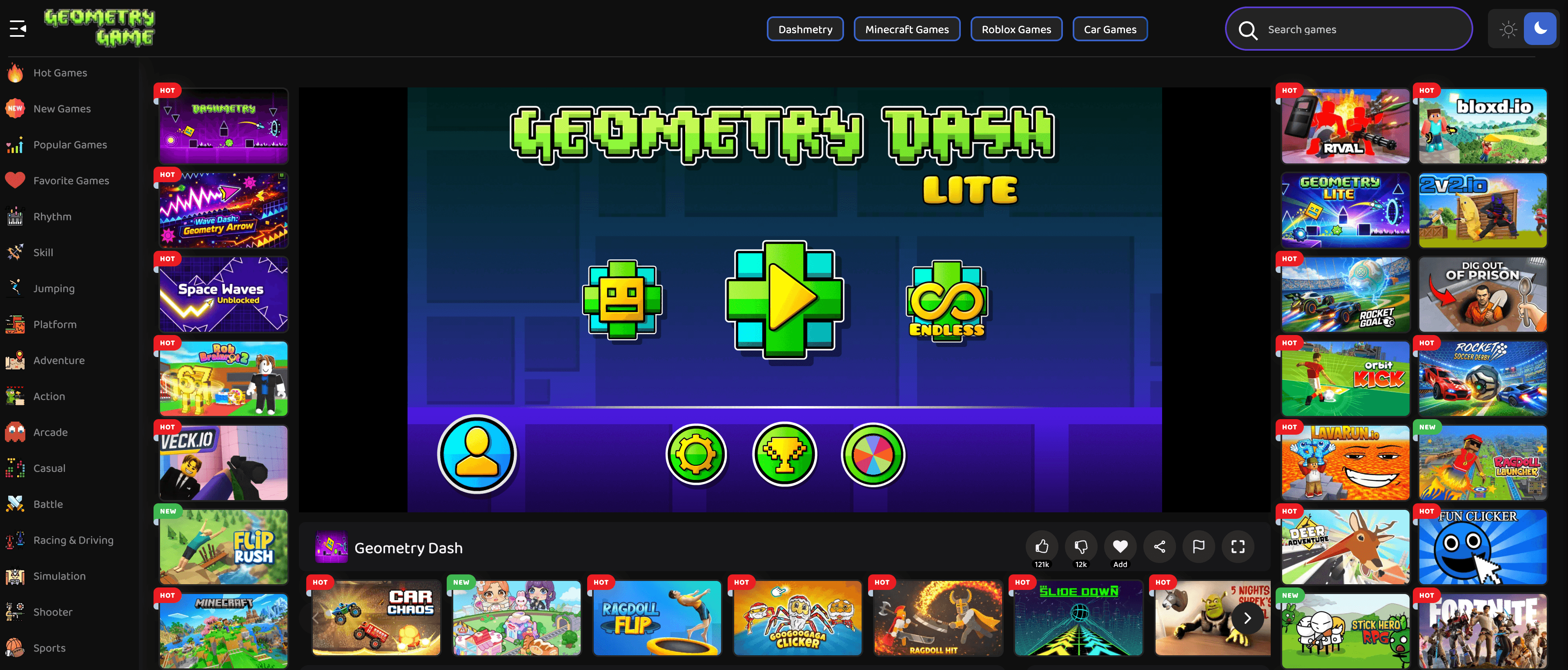
Everything at Geometry Games moves forward with or without your permission. Your geometric icon auto-runs through music-synced obstacle courses, and portals scattered through each level transform it between cube, ship, wave, UFO, ball, and spider modes, each with different movement rules. Difficulty is graded seriously: beyond the normal ratings sit Easy, Medium, Hard, Insane, and Extreme Demon subcategories, with Extreme Demon reserved for players who have memorized every frame of a level.
Practice Mode and the Spin-Off Shelf
Practice Mode is the sane way to learn a hard map: drop checkpoints at brutal sections and rehearse them without restarting from the beginning. Once the original Geometry Dash feels familiar, the site keeps a shelf of fan-made variants going:
- Dashmetry, a creative take on the classic formula with its own level designs
- Wave Dash: Geometry Arrow, built around precision wave control
- Space Waves Unblocked, a space-themed wave-mode challenge
- Rob Brainrot 2, a community spin-off with humorous, punishing levels
Categories extend past rhythm and skill games into platform, racing and driving, and Minecraft- and Roblox-themed crossovers.
A Comment Section That Actually Gets Used
The community layer has real activity behind it: comment threads with hundreds of player discussions, like and dislike voting on games and levels, share tools, and a dedicated bug-report feature. Community-driven difficulty ratings help you judge in advance if a level is a warm-up or a wall. The site also maintains connected accounts on YouTube, TikTok, and Facebook.
Update History Back to 2013
Geometry Games tracks the franchise's whole timeline, from the initial 2013 levels through the major 2.2 update in 2023, and currently highlights 2026 news including the upcoming 2.21 version. New community levels and spin-offs are added regularly. Playback details get attention too: full screen mode, a specialized mobile layout, and iframe monitoring that keeps game content rendering correctly. Nothing installs at any point — the whole thing runs in the browser, though the trade-off of unforgiving difficulty means most sessions end in a lot of restarts.