
One Game, 250 Million Opponents
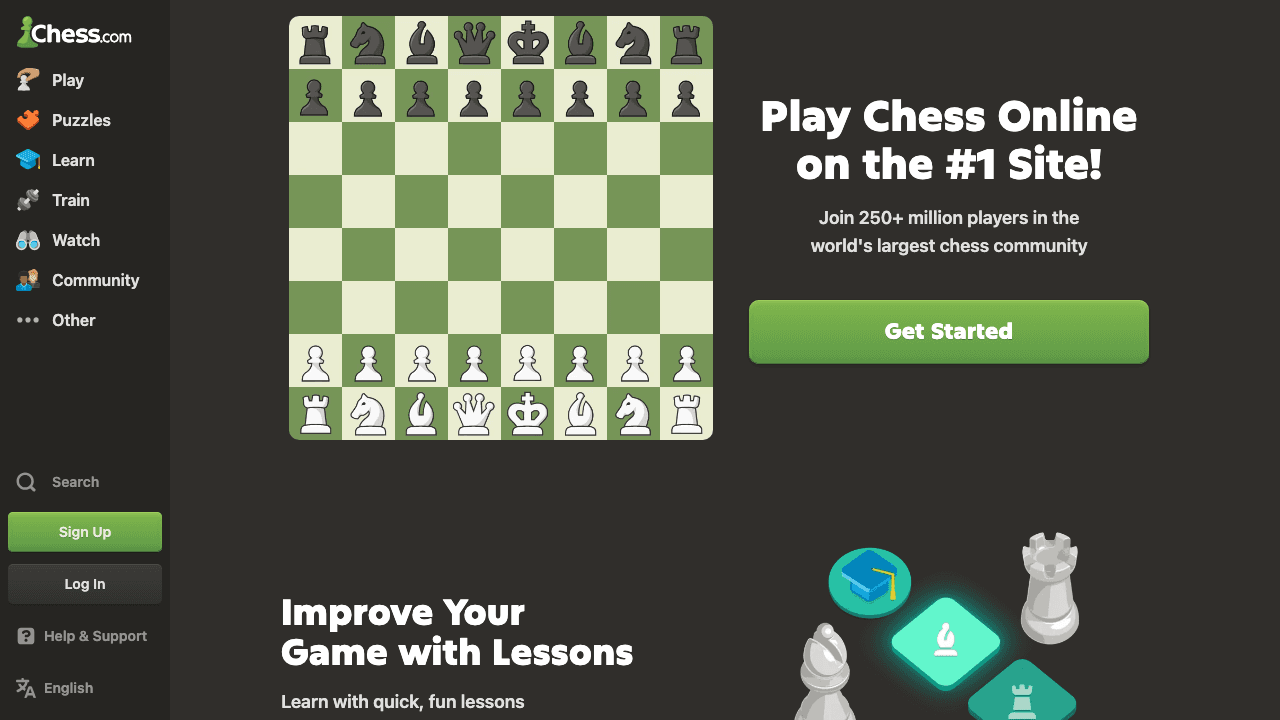
Chess.com claims a community of more than 250 million players, and the practical upshot is simple: an opponent of your level is available at any hour. The self-declared "#1 Site" for online chess runs entirely in the browser, with native apps on the Apple App Store and Google Play and progress that syncs across devices. Rating-based matchmaking keeps games competitive from first-week beginner to titled master.
Bullet, Bots, and the Watch Tab
Live chess runs at every time control, from bullet sprints to daily correspondence games that unfold over days. If humans feel intimidating, bot matches offer computer personalities that vary widely in skill and playstyle. At the spectator end, the Watch section carries live broadcasts of elite tournaments with move-by-move, real-time analysis, so the site covers the professional calendar as thoroughly as it hosts amateur games.
Puzzle Rush and the Lessons Library
The training side is deep. The puzzle bank holds thousands of tactical problems, including a daily puzzle and the timed Puzzle Rush format, with themed tactics for targeted practice. The Learn section pairs quick, approachable lessons with structured training plans that run from beginner through advanced, and as a live service the site refreshes puzzles and events daily.
What Free Covers and What It Doesn't
Free registration unlocks the core experience of unlimited games along with puzzles and basic lessons. Paid memberships expand lesson access, deeper analysis, and higher puzzle limits, which is the honest catch: the serious training tools sit behind a subscription. A published fair-play policy backed by anti-cheating enforcement keeps rated games trustworthy.
Clubs, Forums, and a Developer Corner
Community gets its own slot in the main navigation, anchoring clubs and discussion forums. The platform also maintains a large social footprint across TikTok, Twitter/X, YouTube, Twitch, Instagram, and Discord, and there is even a dedicated club for developers. Since every game needs two players, the community is less a feature of the site than its substance.